Cultivating cannabis in a grow tent demands meticulous environmental control, with humidity being a cornerstone of plant health and yield. Without adequate moisture, your plants can suffer from brittle leaves, stunted growth, and a significant reduction in overall yield. This comprehensive guide, crafted by a technician with over a decade of experience in humidification technology, will help you navigate the world of grow tent humidifiers, ensuring your cannabis plants thrive from seedling to harvest.
What Are Humidifiers and Why Are They Crucial for Cannabis Grow Tents?
A humidifier is an essential device that introduces moisture into the air, creating a controlled environment vital for the various growth stages of cannabis plants. In arid climates or during certain times of the year, indoor grow tents often struggle to maintain the naturally high humidity levels cannabis thrives in.
Using a humidifier mitigates several critical issues:
- Prevents Dehydration: Adequate humidity allows plants to absorb moisture through their leaves, preventing drying out and signs of dehydration.
- Optimizes Photosynthesis: When humidity levels are too low, plant stomata (pores on leaves) can close, hindering CO2 uptake and making photosynthesis less efficient, slowing growth.
- Aids Nutrient Uptake: Inadequate humidity can lead to nutrient burn as plants absorb too much water and nutrients through their roots if they can’t effectively transpire through their leaves.
- Supports Growth Stages: Different growth phases require specific humidity ranges to promote robust development and maximum yield.
Maintaining precise humidity levels is not just about avoiding problems; it’s about actively promoting vigorous growth and ensuring your plants reach their full potential.
Ideal Humidity Levels for Cannabis Plants by Growth Stage
|
Our Picks for the Best Humidifier in 2026
As an Amazon Associate I earn from qualifying purchases.
|
||
| Num | Product | Action |
|---|---|---|
| 1 | Dreo Humidifiers for Bedroom, 4L Top Fill for Large Room, 36H Runtime, 28 dB Quiet Supersized Cool Mist Air Humidifier for Baby Nursery, Plants, Indoor, Night Light, Easy to Clean & Fill, White |

|
| 2 | BOXING 3L Cool Mist Humidifiers, Ultra Quiet 20dB for Bedroom, Baby & Office, Top Fill Air Humidifier for Large Room Home & Indoor Plants, 30H Runtime, Essential Oil Tray, Night Light, BPA-Free, White |
|
| 3 | LEVOIT Top Fill Humidifiers for Bedroom, 2.5L Tank for Large Room, Easy to Fill & Clean, 28dB Quiet Cool Mist Air Humidifier for Home Baby Nursery & Plants, Auto Shut-off for Safety, 25H |
|
| 4 | MegaWise Topfill 7-colour Night light humidifier for Kid bedroom with 3.5L Large Capacity, No leakage Design Fine Mist Output Auto Shutoff, Essential Oil Safe Tank |
|
| 5 | Homvana Humidifiers for Bedroom Home, 3.6 L Cool Mist Top-Fill 34H Super Long Time, Quiet 23dB, Baby Humidifier, Oil Diffuser for Large Room, House, Plant, Nursery, Office, BPA FREE, Ultrasonic (Grey) |
|
| 6 | LEVOIT - Humidifiers for Bedroom - Quiet (3L Water Tank) - Cool Mist/Top Fill/Essential Oil Diffuser/25Watt - Home/Large Room - 360° Nozzle - Rapid Ultrasonic Humidification for Baby Nursery/Plant |
|
| 7 | Dreo Smart Humidifiers for Bedroom, Top Fill 4L Supersized Humidifier Large Room with 28 dB, 36H Runtime, Touch/APP/Voice Control, Nightlight, Cool Mist Humidifiers for Baby, Plants, Indoor, Black |
|
| 8 | LEVOIT Humidifiers for Bedroom Large Room Home, (6L) Cool Mist Top Fill Essential Oil Diffuser for Baby & Plants, Smart App & Voice Control, Rapid Humidification & Auto Mode - Quiet Sleep Mode, Gray |
|
| 9 | BREEZOME 6L Humidifiers for Bedroom Large Room & Essential Oil Diffuser, Ultrasonic Top Fill Cool Mist Humidifiers for Baby, Plants, Nursery Last up to 60 Hours, Smart Humidistat Control, Quiet, Black |
|
| 10 | Humidifiers for Bedroom Large Room with 7L/1.85Gal Large Humidifier, Smart App & Remote Control, 4 Mist Levels Large Room Humidifiers for Home Midnight |
|
The optimal relative humidity (RH) varies significantly throughout a cannabis plant’s life cycle. Tailoring your humidifier’s output to these stages is key to success.
| Plant Stage | Recommended Relative Humidity (RH) |
|---|---|
| Propagation | 75-90% |
| Seedlings | 65-70% |
| Vegetative | 40-60% (ideally 45-55%) |
| Flowering | 40-50% (can drop below 40% pre-harvest) |
| Drying | 50-55% |
Note: These ranges can fluctuate slightly based on temperature and specific strain genetics, but serve as excellent guidelines.
Common Humidifier Types: Pros and Cons for Grow Tents
Understanding the different types of humidifiers available will help you select the best fit for your grow tent’s unique needs.
1. Evaporative Humidifiers
Evaporative humidifiers use a fan to draw air through a moistened wick filter, releasing cool, invisible moisture into the air.
- Principle of Operation: A fan blows air over a wet wick filter, which absorbs water from a reservoir. The water evaporates, increasing humidity.
- Pros:
- Self-regulating: They typically add humidity until the air is saturated, making them less likely to over-humidify.
- Energy-efficient: Generally consume less power than warm mist options.
- Germ-free mist: Some models, like the Honeywell HCM350W, include UV technology to kill bacteria in the water, producing a cleaner mist.
- Cons:
- Filter replacement: Wicking filters need frequent replacement (every 3-6 weeks), which can be an ongoing expense.
- Mineral buildup: Filters can accumulate mineral deposits quickly, especially with hard water, requiring more frequent cleaning or replacement.
- Noise: Can be louder due to the fan.
2. Ultrasonic Humidifiers
Ultrasonic humidifiers use high-frequency vibrations to create a super-fine mist that is quietly dispersed into the air.
- Principle of Operation: A ceramic diaphragm vibrates at an ultrasonic frequency, breaking water into tiny particles that form a cool mist.
- Pros:
- Quiet Operation: They are typically very quiet, a significant advantage in residential settings.
- Fine Mist Output: Creates a fine, cool mist that is easily absorbed by the air.
- Precise Control: Many models, such as the AC Infinity Cloudforge T3 and Spider Farmer Cool Mist, offer smart controls, allowing for precise adjustments of mist output and scheduling via apps.
- Cons:
- “White Dust”: If hard tap water is used, minerals can be dispersed as fine white dust, which can settle on plants and equipment. Using distilled or reverse osmosis (RO) water is highly recommended to prevent this.
- Algae Growth: Transparent water tanks can be prone to algae growth if not cleaned regularly.
- Water accumulation: Some designs may have water accumulation in the hose or tubing.
3. Steam Vaporizers (Warm Mist Humidifiers)
Steam vaporizers heat water to create steam, which is then released into the air.
- Principle of Operation: An internal heating element boils water, producing sterile steam that cools before exiting the unit.
- Pros:
- Sterile Mist: The boiling process kills most bacteria and molds in the water.
- Can help raise tent temperature: The warm mist can slightly increase ambient temperature, which might be beneficial in cooler environments.
- Cons:
- Higher Energy Consumption: Heating water requires more electricity than other types.
- Burn Risk: The hot steam can pose a burn hazard, especially in confined spaces like grow tents.
- Mineral Buildup: Can still experience significant mineral buildup on heating elements, requiring frequent descaling.
4. Impeller Humidifiers
Impeller humidifiers use a rotating disc to fling water at a diffuser, breaking it into fine droplets.
- Principle of Operation: A high-speed rotating disc creates a fine mist without a heating element.
- Pros:
- Safe: No hot water, reducing burn risk.
- Energy-efficient: Less power consumption than steam models.
- Cons:
- Noise: Can be noisy due to the rotating components.
- Limited output: Generally have lower mist output compared to ultrasonic or evaporative models, making them less suitable for larger grow tents.
5. Whole-Home Humidifiers
Designed for large residential spaces, these can be adapted for very large grow rooms or greenhouses.
- Principle of Operation: Often integrated with HVAC systems or large standalone units that use evaporative or misting technology to humidify vast areas.
- Pros:
- Massive Capacity: Can cover thousands of square feet, ideal for commercial-scale operations.
- Automated Control: Advanced systems allow for precise, whole-room humidity management.
- Cons:
- Cost & Installation: Very expensive and typically require professional installation.
- Size & Noise: Large footprint and some models can be noisy.
- Maintenance: More complex maintenance due to integration and scale.
Comparison Table: Humidifier Types for Grow Tents
This table summarizes the key characteristics to help you quickly compare options:
| Feature | Evaporative | Ultrasonic | Steam Vaporizer | Impeller | Whole-Home |
|---|---|---|---|---|---|
| Operation | Fan over wet wick | High-frequency vibrations | Boiling water (steam) | Rotating disc (fine droplets) | Integrated or large standalone |
| Mist Type | Invisible cool mist | Visible cool mist (fine fog) | Warm, sterile mist | Fine cool mist | Varies (evaporative/mist) |
| Noise Level | Moderate (fan) | Very quiet | Quiet | Moderate to high | Varies (can be noisy) |
| Energy Use | Low to Moderate | Low | High | Low | Moderate to High |
| Filter Needs | Yes (regular replacement) | No (can have demineralization cartridge) | No (but heating element scaling) | No | Yes (filter, water panel) |
| Maintenance | Frequent filter replacement, cleaning | Regular cleaning, distilled water for “white dust” | Descaling heating element, cleaning | Regular cleaning | Complex, professional installation/service |
| “White Dust” | No | Yes (with hard water) | No (sterile steam) | Less common | Varies |
| Best For | Balanced humidity, germ-free mist | Quiet operation, precise control | Sterile air, slight temp increase | Safety, basic humidification | Very large grow rooms/greenhouses |
Grow Tent Humidifier Buying Guide: Essential Factors to Consider
Choosing the ideal humidifier involves more than just picking a type. Consider these crucial factors to match the device to your specific grow tent setup:
Grow Tent Size and Coverage Area
The size of your grow tent directly impacts the humidifier’s required output. A humidifier rated for a large room will overwhelm a small tent, leading to excessively high humidity and potential mold issues. Conversely, a small unit won’t adequately humidify a larger space. Always check the manufacturer’s specifications for maximum room coverage. For instance, a Levoit Classic 100 handles up to 290 square feet, while a commercial unit like the Aprilaire 500 can cover up to 3,500 square feet.
Water Tank Capacity & Refill Convenience
A larger water tank means less frequent refilling, which is a significant convenience, especially during critical growth stages. Consider how long a humidifier can run on a single tank fill. Some models offer up to 24-45 hours of runtime. Additionally, look for tanks with wide openings or top-fill designs, making refills and cleaning much easier. Narrow-necked tanks can be a hassle to maintain.
Humidistat and Smart Controls
An integrated humidistat is indispensable. This feature allows you to set a target humidity level, and the humidifier will automatically turn on or off to maintain it. This prevents both under and over-humidification and saves electricity. Many modern humidifiers for grow tents, such as those from AC Infinity and Spider Farmer, offer advanced smart controls, app integration, and external sensor probes for real-time monitoring and automation, ensuring precise environmental regulation.
Noise Level
If your grow tent is in a living area or a space where noise is a concern, opt for quieter models, particularly ultrasonic humidifiers. Evaporative units with fans can be more noticeable. Always check decibel ratings if available.
Ease of Cleaning and Maintenance
Regular cleaning is paramount to prevent mold, bacteria, and mineral buildup, which can compromise plant health and the humidifier’s lifespan. Look for models with easily removable, portable, and even dishwasher-safe parts. Using distilled or reverse osmosis (RO) water can significantly reduce mineral scale, extending the time between deep cleans. Some humidifiers feature black water tanks, which can help decrease algae growth.
Budget and Running Costs
Consider both the initial purchase price and ongoing operational costs. While some humidifiers are affordable upfront, models requiring frequent filter replacements (like evaporative types) will incur continuous expenses. Factor in the cost of distilled water if you opt for an ultrasonic unit in an area with hard water.
Additional Features
Look for beneficial extras such as:
- Extendable Hoses: Allow for targeted misting and even distribution of humidity throughout the tent.
- Automatic Shut-off: A safety feature that turns the unit off when the water tank is empty.
- Low Water Indicators: Alerts you when it’s time for a refill.
- UV Sterilization: Found in some evaporative models to ensure germ-free mist.
Top-Rated Humidifiers for Cannabis Grow Tents
Based on their features, performance, and suitability for grow tent environments, here are some of the most popular and effective humidifiers currently on the market:
1. Levoit Classic 100 Cool-Mist Humidifier: Best Budget-Wise Option
- Key Specs: 2.4 Liters capacity, covers up to 290 sq ft, up to 24 hours runtime.
- Pros: Highly affordable, features adjustable mist output, a built-in humidistat for customized levels, and ultrasonic micro-mist technology with a 360-degree rotating nozzle for even dispersion. Includes automatic shut-off and a low water indicator.
- Cons: Egg-like shape can be inconvenient to clean due to a narrower neck, and its design may not blend seamlessly with dark-themed grow tents.
2. Honeywell HCM350W Cool Mist Humidifier: Best Germ-Free Grow Tent Humidifier
- Key Specs: 1.1 gallon capacity, covers up to 800 sq ft, up to 24 hours runtime.
- Pros: Utilizes UV technology to eliminate 99.9% of bacteria, producing germ-free mist. Easy to use and maintain with dishwasher-safe parts and a self-regulating evaporative system. Features an easy-to-refill tank with a handle.
- Cons: Requires frequent wick filter replacement (every 3-6 weeks), which adds to ongoing costs. Mineral buildup on filters is common, and some users question the effectiveness of the UV light.
3. AC Infinity Cloudforge T3 Plant Humidifier: Best for Smart Growing
- Key Specs: 4.5 Liters capacity, maximum 45 hours runtime, designed for plant cultivation.
- Pros: Integrates smart technology with precise vapor output control (10 levels) via an EC ultrasonic vaporizer. Comes with a corded sensor probe for accurate real-time humidity readings and extendable tubing for flexible placement. Ideal for growers seeking advanced environmental management.
- Cons: The transparent water tank may be susceptible to algae growth, and water can accumulate in the hose, potentially requiring careful positioning.
4. Spider Farmer Cool Mist Humidifier for Plants: Best for Indoor Growing with Smart App Control
- Key Specs: 5 Liters capacity, maximum 28 hours runtime, black water tank.
- Pros: Features smart app control via the GGS series, allowing remote adjustment of mist levels, scheduling, and real-time monitoring of temperature, humidity, and light cycles. Offers four adjustable mist levels and an adjustable extendable hose for targeted misting. The black tank design significantly reduces algae chances, promoting healthier plants.
- Cons: Specific integration with Spider Farmer’s GGS series might limit compatibility with other smart systems if not already part of the ecosystem.
5. Aprilaire 500 Whole-Home Humidifier: Best for Large Spaces
- Key Specs: 12 gallons/day capacity, covers up to 3,500 sq ft.
- Pros: Distributes moisture evenly across vast areas using a water panel evaporator. Offers automatic digital control with a built-in humidity sensor and a bypass damper for efficient operation, making it suitable for large grow rooms or greenhouses.
- Cons: Requires professional installation, can be noisy, and users have reported issues with leaks if not properly maintained.
Using and Maintaining Your Grow Tent Humidifier for Peak Performance
Even the best humidifier won’t perform optimally without proper setup and consistent maintenance.
Placement Matters
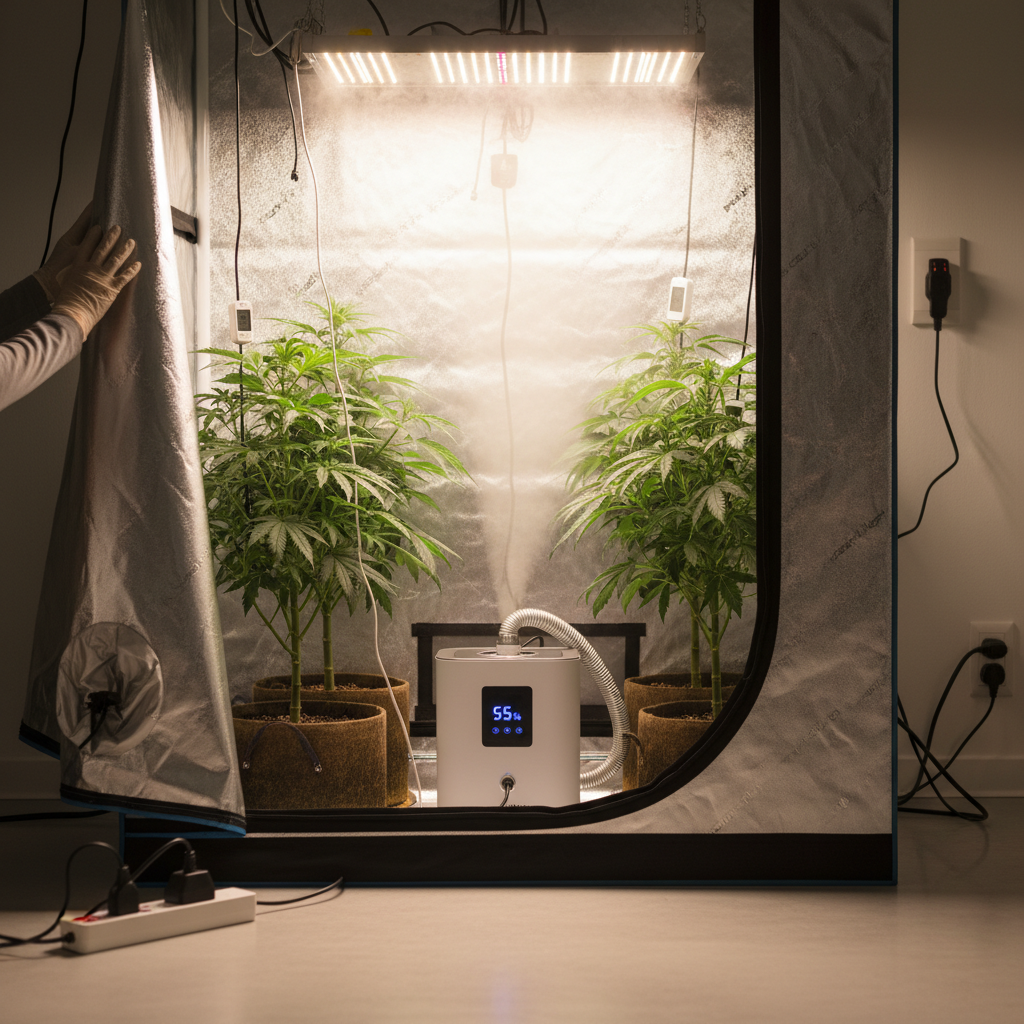
Strategic placement is crucial for even humidity distribution. Position your humidifier near the air intake area or an oscillating fan to help circulate the humidified air throughout the tent. Avoid placing it too close to your plants, as direct mist can lead to water spots, mold, or damage to delicate foliage. Ensuring that the mist disperses effectively is key to maintaining a uniform environment.
Water Quality: A Game Changer
The quality of water you use directly impacts your humidifier’s performance and maintenance frequency. Hard tap water contains minerals that, when aerosolized by ultrasonic humidifiers, create “white dust” that can coat your plants and equipment. In evaporative units, these minerals accelerate filter clogging.
- Recommendation: Use distilled water or water purified by reverse osmosis (RO) to minimize mineral buildup and extend the life of your unit and its components.
Regular Cleaning is Non-Negotiable
Humidifiers create a moist environment that, if not cleaned regularly, can become a breeding ground for mold, mildew, and bacteria.
- Weekly Cleaning: At least once a week, especially with hard water, disassemble your humidifier, wipe down all parts, and run a cleaning solution through it.
- Descaling Solutions: For mineral scale buildup, a solution of white vinegar, citric acid, or commercial descalers like CLR (Calcium, Lime, Rust) can be highly effective. Soak affected elements for a few hours, then scrub off any remaining deposits.
- Air Drying: Allow all components to thoroughly air dry before reassembly to prevent mold growth.
“Consistent cleaning and using the right water source are often overlooked, but they are the bedrock of efficient humidification and healthy plants.” – Reviewook Admin, Humidification Expert
Monitoring Humidity
Always use a reliable hygrometer (humidity meter) placed within your grow tent to monitor current humidity levels. This allows you to verify your humidifier’s settings and make any necessary adjustments to ensure your plants are always within their ideal RH range.
Frequently Asked Questions About Grow Tent Humidifiers
Should I put a humidifier in my grow tent?
Yes, if the humidity levels in your grow tent consistently fall below the ideal range of 40-60% for vegetative and flowering stages, or 65-90% for seedlings and clones, a humidifier is highly recommended to prevent plant stress and promote healthy growth.
What kind of humidifier do I need for my grow tent?
The best kind of humidifier depends on your grow tent’s size, your budget, desired features like smart control or quiet operation, and maintenance preferences. Ultrasonic cool mist humidifiers are popular for their quiet operation and fine mist, while evaporative units offer germ-free mist and are generally energy-efficient.
What is the best way to humidify a grow tent?
Using an electronic humidifier is the most effective and precise way to humidify a grow tent. Unlike manual methods like misting or open water trays, a humidifier with a built-in humidistat provides accurate, customizable, and effortless control over humidity levels.
Do I need a humidifier or dehumidifier for my grow tent?
This depends on your grow tent’s ambient humidity. If the air is too dry (below 40-60% for established plants), you need a humidifier. If the humidity is too high (above 60% during flowering, for example), you’ll need a dehumidifier to prevent mold and mildew. Many growers use both to maintain optimal conditions.
Where should a humidifier be placed in a grow tent?
Place your humidifier near the air intake or an internal circulation fan to ensure the mist is evenly distributed throughout the grow tent. Avoid positioning it directly on plants to prevent waterlogging and potential mold issues.
Conclusion
Mastering humidity control in your cannabis grow tent is a critical step towards achieving bountiful harvests and robust, healthy plants. By understanding the specific needs of each growth stage and choosing the right humidifier, you empower your cultivation efforts with precision and efficiency. Whether you opt for a budget-friendly ultrasonic unit or a smart-controlled evaporative system, the key lies in diligent monitoring and maintenance.
Are you ready to optimize your grow tent’s environment and unlock your plants’ full potential?